
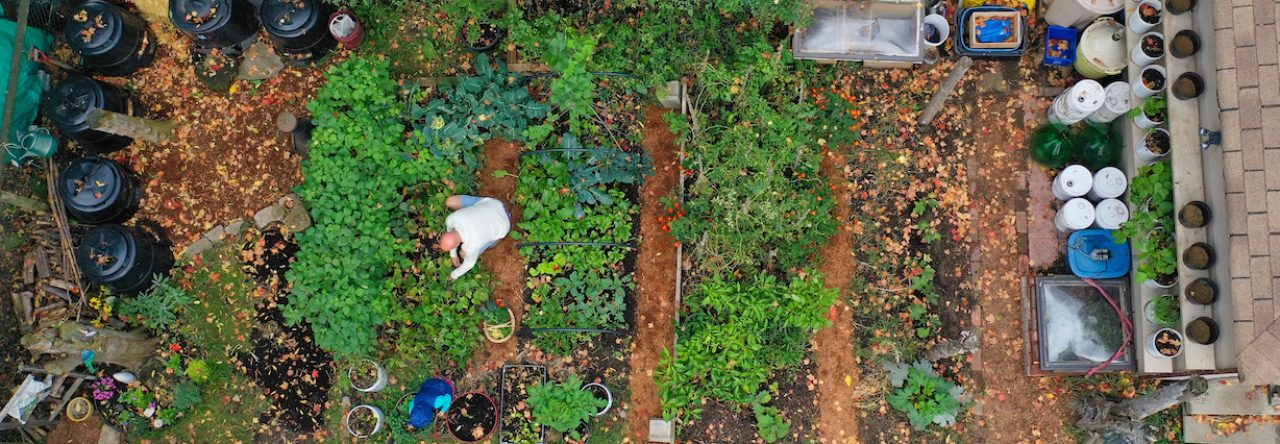
FIELD SCHOOL is Crooked Farmz’ annual pedagogical program blending theory, practical, hands-on worker bee, mutual aid, shared food, and community. All workshops will take place at the Crooked Farmz plot at the Many Hands Urban Farm in Downsview Park.
There is a nominal pwyc fee to join a Crooked Farmz Field School event as a full Participant. If you enjoy the topic but cannot make the event or you would like to otherwise support our pedagogical program, you can also choose to become a Sponsor so that we can continue to offer pwyc flexibility for our events to other interested growers.
New Fruit Tree Plantings
Tuesday, September 8, 2026
10:00am–12:00pm
$10/pwyc
A newly planted tree spends its first two seasons mostly underground — roots pushing past the transplant hole, mycorrhizal fungi negotiating a new partnership, bark healing from the shock of relocation. Get this establishment window wrong and a tree limps for a decade; get it right and it never looks back.
In this Fall Field School session, we will plant a handful of new fruit trees directly into CRAY’s orchard rows — correct planting depth, root flare exposure, staking, and mulching technique, all done hands-on rather than demonstrated. Participants will each get planting time with a tree and learn to read a nursery rootstock tag for what it tells you about eventual size and vigour. Registered participants take home a jar of fresh compost tea.
This workshop will be of particular interest to home gardeners, market growers, and landscape professionals planning new tree plantings of their own.
Cover Crops and Soil Occultation
Thursday, September 10, 2026
10:00am–12:00pm
$10/pwyc
Bare soil is a soil food web’s worst enemy — exposed to erosion, UV degradation, and a collapse in root exudates that feed the biology below. Cover cropping and occultation (tarping to exclude light) are two different answers to the same problem: keep the soil armoured and biologically active between cash crops.
In this Fall Field School session, we will compare cover crop selection for fall soil-building against tarping as a stale-seedbed and weed-suppression tool, including timing considerations for a Zone 6b fall transition. Participants will look at active cover crop stands and discuss termination timing for spring planting. Registered participants take home a jar of fresh compost tea.
This workshop will be of particular interest to market gardeners, ecological farmers, and home gardeners managing fall bed turnover.
Compost Tea and Soil Inoculation
Thursday, September 17, 2026
10:00am–12:00pm
$10/pwyc
Compost holds a snapshot of microbial diversity, but that biology has to move into the soil profile to do any good. Aerobic compost tea extraction pulls bacteria, fungi, protozoa, and nematodes off a finished compost and multiplies them in an oxygenated brew — a living inoculant with a 24–48 hour window that puts biology directly into contact with roots.
In this Fall Field School session, we will cover the aerobic extraction process, dilution and application rates, and how seasonal recipe changes (fungal-forward in spring, bacterial-forward through summer) track crop needs across the growing year. Participants will observe an active brew and take home a jar of freshly brewed tea to apply themselves.
This workshop will be of particular interest to gardeners, market growers, and landscape professionals interested in biological soil inoculation.
Flexible Infill Agriculture
Sunday, September 20, 2026
9:00–11:00am
$10/pwyc
Most usable growing space in a city isn’t a farm — it’s a boulevard, a vacant lot, a driveway, a strip beside a building. Infill agriculture works with land that’s temporary, irregular, or informally accessed, which means growing systems have to be flexible: low-commitment, easy to relocate, and resilient to interruption.
In this Fall Field School session, we will discuss how Crooked Farmz has used underutilized urban space across its eight seasons, strategies for negotiating access to informal growing sites, and low-infrastructure growing approaches suited to land you might not hold long-term. Participants will discuss their own potential infill sites and troubleshoot access and soil challenges together. This “Sunday Breakfast Club” hands-on workshop will be followed by coffee and light refreshments.
This workshop will be of particular interest to independent farmers, market gardeners, and those considering a transition into small-scale urban agriculture.
Soil Prep for Spring Plantings
Tuesday, September 22, 2026
10:00am–12:00pm
$10/pwyc
Fall is when next spring’s orchard is actually built. Soil structure, organic matter, and biological activity laid down now — while roots are still active and soil temperatures still favour microbial work — determine how well a planting site performs eight months from now.
In this Fall Field School session, we will strip-till and sow a decompaction-focused cover crop into the bed slated to become next spring’s rhubarb alley — a hands-on demonstration of preparing compacted soil for a long-lived perennial planting without a full tillage pass. We’ll cover why strip-tilling, rather than broadcast tillage, preserves soil structure between rows, which cover crop species break up compaction most effectively, and the termination timing needed to have a clean bed ready for planting come spring. Participants will help lay out and seed the strip-tilled rows themselves. Registered participants take home a jar of fresh compost tea.
This workshop will be of particular interest to market gardeners and home growers preparing beds for perennial plantings.
Three-Bin Composting
Thursday, September 24, 2026
10:00am–12:00pm
$10/pwyc
A three-bin system solves the central problem of hot composting at small scale: you need somewhere to turn a pile into, and somewhere else to cure finished material without tying up your active bin. Done right, the three-bin layout lets a single grower run continuous batches without the pile ever stalling for lack of space.
In this Fall Field School session, we will cover carbon:nitrogen ratios, turn timing keyed to internal temperature, and a layout that keeps a curing heap decoupled from active hot-processing. Participants will handle a working pile and practice reading temperature and moisture as management cues. Registered participants take home a jar of fresh compost tea.
This workshop will be of particular interest to home gardeners and market growers managing composting at a household-to-small-farm scale.
Invasive Species Removal (Phragmites Control)
Sunday, September 27, 2026
9:00–11:00am
$10/pwyc
An invasive species isn’t a moral failing of the plant — it’s an organism thriving in a disturbed ecosystem that’s lost the checks that kept it in balance elsewhere. Phragmites australis is a textbook case: a wetland reed that spreads by rhizome and seed alike, forming monocultures that choke out native marsh species along pond and wetland edges.
In this Fall Field School session, we will focus on phragmites control at CRAY’s food forest pond edge — identification, why it outcompetes native wetland plants so effectively, and removal approaches matched to its rhizome-and-seed reproductive strategy. Participants will work hands-on managing phragmites on-site. This “Sunday Breakfast Club” hands-on workshop will be followed by coffee and light refreshments.
This workshop will be of particular interest to gardeners, growers, and land stewards managing invasive wetland species on their own sites.
Traditional Apple Orchard
Tuesday, September 29, 2026
10:00am–12:00pm
$10/pwyc
Before dwarf rootstock and trellis systems, orchards were built on standard rootstock, wide spacing, and cultivar diversity bred for storage, cider, and regional resilience rather than shelf appearance. That diversity isn’t nostalgia — a row of sixteen varieties spreads disease pressure and pollination risk in a way a single-cultivar block never can.
In this Fall Field School session, we will walk CRAY’s heritage apple row to discuss cultivar selection, pollination groups, and how varietal biodiversity within a single tree row functions as a form of disease and climate resilience. This is a discussion-based walk through the row rather than a hands-on pruning session. Registered participants take home a jar of fresh compost tea.
This workshop will be of particular interest to home gardeners, market growers, and those curious about heritage and cider apple cultivation.
Weeds as Indicators
Thursday, October 1, 2026
10:00am–12:00pm
$10/pwyc
A weed stand is a diagnostic tool if you know how to read it. Compaction, pH extremes, low fertility, and poor drainage each favour a different set of opportunistic species — which means the “problem” plants growing in a bed are often telling you exactly what’s wrong with the soil underneath them.
In this Fall Field School session, we will walk through common indicator species found around CRAY and East York growing spaces, what each signals about underlying soil conditions, and how to use that information to guide amendment rather than just pulling and reseeding. Participants will practice on-site plant ID and soil-condition matching. Registered participants take home a jar of fresh compost tea.
This workshop will be of particular interest to gardeners and growers of all experience levels who are curious about reading soil condition through plant behaviour.
Grapes and Vine Culture
Tuesday, October 6, 2026
10:00am–12:00pm
$10/pwyc
A grapevine’s relationship to soil is unusually direct — root stress, drainage, and mineral content show up in the fruit itself. But none of that matters if the vine has nowhere to go: trellis structure determines sun exposure, airflow, and how the whole plant’s energy gets allocated between fruit and wood.
In this Fall Field School session, we will assess vine health and cover trellis design and construction — the training systems that shape a vine’s productivity for its whole life. Participants will help build and set trellis infrastructure on-site. Registered participants take home a jar of fresh compost tea.
This workshop will be of particular interest to home gardeners and market growers considering grapes as a perennial addition to their growing space.
Bokashi Composting
Thursday, October 8, 2026
10:00am–12:00pm
$10/pwyc
Bokashi sidesteps the aerobic, high-heat model of composting entirely. Using an inoculum of lactic acid bacteria and other anaerobic microorganisms, it ferments kitchen scraps — including meat, dairy, and cooked food that would normally be off-limits — into a pre-compost that finishes breaking down quickly once buried in soil.
In this Fall Field School session, we will cover the fermentation process, inoculum (bokashi bran) preparation, bucket system setup, and how to finish fermented material in-ground or in a secondary compost system. Participants will sample an active ferment and leave with a starter batch of inoculum. Registered participants take home a jar of fresh compost tea.
This workshop will be of particular interest to apartment and small-space dwellers, and home gardeners looking for an indoor-friendly composting method.
Landrace Seed Saving
Sunday, October 11, 2026
9:00–11:00am
$10/pwyc
Landrace populations carry genetic diversity that a stable, single-cultivar seed line simply cannot — each generation reselected under real local conditions, so drought years favour drought-tolerant individuals and wet years favour the opposite. Saved carefully across seasons, that population becomes progressively better adapted to the exact soil and climate it’s grown in.
In this Fall Field School session, we will cover open-pollination basics, population size and isolation distance for maintaining genetic diversity, and selection criteria for building a landrace population suited to Toronto’s Zone 6b conditions. Participants will process seed from this season’s landrace tomato trials and take home seed to grow next year. This “Sunday Breakfast Club” hands-on workshop will be followed by coffee and light refreshments.
This workshop will be of particular interest to market gardeners, ecological farmers, and home growers interested in seed sovereignty and long-term crop adaptation.
Permaculture Food Forests
Tuesday, October 13, 2026
10:00am–12:00pm
$10/pwyc
A food forest borrows its structure from a natural woodland edge — canopy, understory, shrub, herbaceous, and root layers stacked to occupy every available niche of light and space. None of that works without reading the site first: where water moves, where it pools, where light actually falls through a season.
In this Fall Field School session, we will read CRAY’s food forest site for water flow and microclimate, then work together as a group to sketch guild layouts and successional plantings for the space. This is a collaborative design session — bring your own site’s constraints if you’re working through a food forest plan of your own. Registered participants take home a jar of fresh compost tea.
This workshop will be of particular interest to home gardeners, market growers, and those interested in permaculture design principles.
Vermicomposting
Thursday, October 15, 2026
10:00am–12:00pm
$10/pwyc
Red wiggler castings are more than digested food scraps — the worm gut itself is a biological inoculant, concentrating beneficial bacteria and fungi as material passes through it. A well-run worm bin produces one of the most microbially dense amendments available to a small-scale grower, in a fraction of the space hot composting requires.
In this Fall Field School session, we will cover Eisenia fetida biology and habitat needs, bin setup and feeding rates, and harvesting castings without disturbing the colony. Participants will handle an active worm bin and troubleshoot common problems (odour, mites, moisture imbalance). Registered participants take home a jar of fresh compost tea.
This workshop will be of particular interest to apartment dwellers, home gardeners, and anyone composting in limited indoor or balcony space.
Elderberry Care
Tuesday, October 20, 2026
10:00am–12:00pm
$10/pwyc
Elderberry has been used medicinally for centuries, but the relationship runs both directions. A shrub under stress — poor soil biology, wrong pruning timing, root competition — produces less and weaker fruit; a shrub given real care, in return, gives back generously. Good elderberry care is less a technique than a reciprocal relationship.
In this Fall Field School session, we will discuss elderberry as medicine, and what it means to offer the plant itself good “medicine” — soil biology, pruning timed to its growth cycle, root space — so it can reciprocate in kind. Participants will look at CRAY’s elderberry row as a working example of that exchange. Registered participants take home a jar of fresh compost tea.
This workshop will be of particular interest to home gardeners, market growers, and those interested in medicinal shrub cultivation and reciprocal growing relationships.
Intermediate Thermophilic Composting
Thursday, October 22, 2026
10:00am–12:00pm
$10/pwyc
Getting a pile to heat up is the easy part. Holding a thermophilic pile in the pathogen- and weed-seed-killing range while still protecting the fungal hyphae that make finished compost valuable requires deliberate turn timing — too aggressive and you shred the fungal network you’re trying to build; too passive and temperatures crash.
In this Fall Field School session, building on foundational hot composting knowledge, we will cover feedstock ratios for consistent heating, temperature-triggered (rather than calendar-based) turn scheduling, and tapering turn frequency later in a pile’s life to protect fungal succession. Participants will take pile temperatures and discuss troubleshooting a stalled or overheated pile. Registered participants take home a jar of fresh compost tea.
This workshop will be of particular interest to market gardeners, ecological farmers, and growers with some prior composting experience looking to refine their process.
Irrigation and Fertigation
Sunday, October 25, 2026
9:00–11:00am
$10/pwyc
Water delivery and nutrient delivery are usually treated as separate jobs, but fertigation — dosing soluble nutrients or liquid amendments through an irrigation system — collapses them into one pass, timed to root uptake rather than a separate feeding schedule. It’s also where compost tea and JLF applications can move from hand-watering to something closer to set-and-forget.
In this Fall Field School session, we will cover drip irrigation basics, timing strategies for Toronto’s rainfall patterns, and how to safely inject liquid amendments like compost tea or JADAM preparations through a drip system without clogging emitters. Participants will examine CRAY’s own irrigation setup and troubleshoot common system problems. This “Sunday Breakfast Club” hands-on workshop will be followed by coffee and light refreshments.
This workshop will be of particular interest to market gardeners, ecological farmers, and growers looking to reduce hand-watering labour.
Apple Trees for Urban Spaces
Tuesday, October 27, 2026
10:00am–12:00pm
$10/pwyc
Columnar apple trees carry a genetic mutation that suppresses lateral branching almost entirely — the tree grows as a narrow, fruit-studded spire rather than a spreading canopy. That habit makes them one of the few fruit trees genuinely suited to a boulevard strip, a container, or a two-foot gap beside a driveway.
In this Fall Field School session, we will cover columnar apple genetics and habit, cultivar options, and how minimal-pruning columnar varieties compare to dwarf and trained forms for tight urban spaces. Participants will discuss site assessment for their own small-footprint plantings. Registered participants take home a jar of fresh compost tea.
This workshop will be of particular interest to home gardeners and urban growers working with small lots, boulevards, or container space.
Johnson-Su Composting
Thursday, October 29, 2026
10:00am–12:00pm
$10/pwyc
The Johnson-Su bioreactor takes the opposite approach from hot composting: no turning, no heat spike, just a slow, static, oxygenated build that favours fungal succession over bacterial dominance. The result, held over many months, is a compost with fungal:bacterial ratios and glomalin production that turned, hot-processed compost rarely matches.
In this Fall Field School session, we will cover bioreactor construction, feedstock selection for fungal-forward outcomes, passive aeration design, and the extended maturation timeline the method requires. Participants will examine an active or recently opened bioreactor and discuss how finished material differs in application from conventional compost. Registered participants take home a jar of fresh compost tea.
This workshop will be of particular interest to market gardeners, ecological farmers, and growers interested in fungal-dominant soil amendments.
Containers and Shrubs
Tuesday, November 3, 2026
10:00am–12:00pm
$10/pwyc
Berries and tender fruits — blueberries, currants, figs — often need exactly what a container can offer that open ground can’t: acidic, well-drained soil mix on demand, and the ability to move a tender specimen somewhere protected before a hard frost.
In this Fall Field School session, we will cover container culture for berries and tender fruit species, soil mix requirements specific to acid-loving plants, and overwintering strategies for tender specimens in a Zone 6b container setup. Participants will assess sample plantings and discuss species suited to long-term container growing. Registered participants take home a jar of fresh compost tea.
This workshop will be of particular interest to home gardeners, balcony and rooftop growers, and those growing berries or tender fruit in limited soil volume.
AI for Small Farm Business I: Technical
Tuesday, November 24, 2026
10:00am–12:00pm (via Zoom)
$25/pwyc

The solo proprietor model concentrates every business function — production, marketing, administration, customer relations — in a single person. Time is the binding constraint, and outsourcing is rarely affordable. AI tools offer a specific kind of leverage here: the ability to draft, plan, research, and problem-solve at a speed and volume that would otherwise require a team.
In this Winter Field School session via Zoom, we will work through practical applications of AI for small farm operations — farm planning, crop management, marketing content, grant writing, and business documents — drawing from real examples in the Crooked Farmz context. We will also examine the environmental costs of AI usage and discuss how to use these tools with minimum ecological footprint. No prior experience with AI is required.
This workshop will be of particular interest to independent farmers, market gardeners, and small-scale agricultural entrepreneurs looking to expand their operational capacity without expanding their payroll.
AI for Small Farm Business II: Workshop
Tuesday, December 15, 2026
10:00am–12:00pm (via Zoom)
$25/pwyc
The most effective way to learn a tool is to use it on something that matters. AI for Small Farm Business I introduced the landscape of AI applications for farm operations — what the tools are, what they can do, and how to think about integrating them. Part II is where that knowledge becomes practice.
In this Winter Field School session, participants will work on a real project from their own operation — a marketing piece, a crop plan, a grant draft, a business document — using AI tools in real time, with structured guidance from the facilitator and feedback from peers in the room. No prior experience with AI is required, and you do not need to have taken Part I.
This workshop will be of particular interest to independent farmers, market gardeners, and small-scale agricultural entrepreneurs who learn best by doing and want to leave with something tangible from their own farm business.

