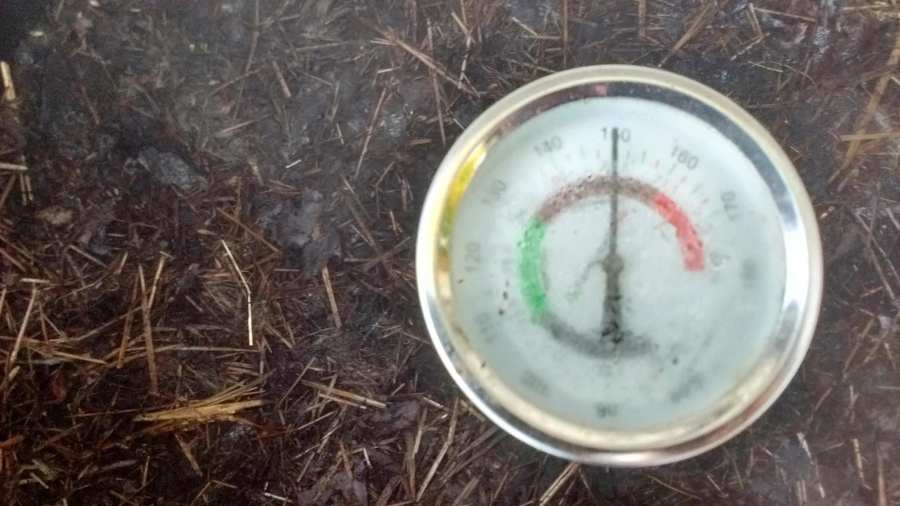
The Crooked Farmz compostery currently features seven dalek-style bin composters, four of which are used for small-batch hot composting cycles (6-8 weeks in length), two of which are used for long-form leaf mould composting (12 months), and one of which is used as the deep maturation reservoir from which inoculant for compost tea is taken.
The compost bins sit on a ‘living floor’ of woodchip mulch that retains water and gradually breaks down over time to encourage a thriving population of microbes and worms underneath the compost bins and in the immediate vicinity.
Feedstocks to produce the compost are primarily sourced from the local area on a ‘just-in-time’ basis for batch production: grass clippings from nearby neighbours, autumn leaves from the park, spent coffee grounds from an independent coffee house, banana peels from a smoothie manufacturer, etc.
Integrated modular system
In 2021 we launched a vermicomposting module to Crooked Farmz to improve our capacity for handling fresh kitchen waste while producing our own worm castings for feeding the soil and supplementing our compost teas.

In 2023 we added a bokashi composting module to the Crooked Farmz compostery. In contrast to our other aerobic techniques of composting, bokashi is an anaerobic method which involves inoculating food scraps with a blend of ‘effective microorganisms’ that serve to ferment rather than decompose organic matter in a low-oxygen environment. More nutrients and a more diverse microbiome are cycled as a result.
Our interest in bokashi relates to the digestive physiology of ruminant animals such as bison or cattle who are so important to nutrient cycling and other ecosystem services in regenerative agriculture: one of their stomachs is a fermentation chamber that allows for complex grasses to be digested and excreted.
We hope to simulate comparable ruminant effects for urban agriculture and horticulture in our integrated system using bokashi techniques as an alternative.
